




Some recommended Books for Vegetable Growers
Here are some of our favourite books. As with our seeds, we only list books that we think are really useful.
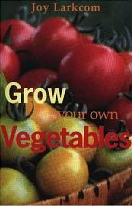 "Grow Your Own Vegetables" by Joy Larkcom. YOU NEED THIS BOOK
This is the book to have if you have any questions about gardening. Even if you never get any other book, this one will sort you out for all your veg-growing questions.
It has just one or two clear paragraphs on each vegetable, explaining how, when and why you grow it in a particular way.
No-nonsense, clear instructions for all the vegetables you could want to grow, with simple explanations of why you do things a particular way rather than being a 'recipe' book.
Brilliant! We keep it to hand for quick reference all the time, even after all these years. Completely organic of course.
£
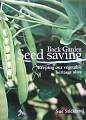 Back Garden Seed Saving by Sue Stickland
Saving your own seed at home is really simple - but just as with growing the vegetables themselves, you need to know what to do for each variety. Seedsaving is easy, fun and the best way to keep our vegetable heritage alive - all you need is a little information to make sure that you do it right!
Your own vegetable seed will be fresher than anything you can buy (even from us) , and better adapted to your conditions, and you'll get huge amounts you can swap with your friends - as long as you follow a few very simple steps to keep things pure.
This book tells you the basics - it's all very easy, and you only need things you'll find in the kitchen like sieves, colanders etc.
We provide basic seedsaving information with all our seeds, but if you really want to develop your seedsaving skills, a good book on the subject is essential.
Here Sue Stickland provides all the information that you could need in an simple, accessible format: why to save your own seed, basic seedsaving techniques, followed by crop by crop instructions for each individual vegetable.
Paperback, 200 pages ....all you need to know about easy home seed saving.
£
OTHER Good Vegetable BOOKS (NOT FOR SALE)
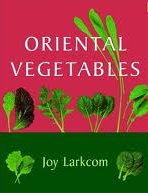 "Oriental Vegetables" - by Joy Larkcom
Another beautiful book by Joy. Based on notes from her long vegetable-exploring trips to China and Japan, this book is a wonderful introduction to the huge range of oriental vegetables that are little known in this country, but easy to grow and delicious to eat.
It was an old ex-library copy of the first edition that really got us enthused about trying out all the oriental veg, and as a result we now have a really good selection in the catalogue. Each individual variety of vegetable included is described in detail, with growing techniques, harvesting instructions and recipes, so you will know exactly what to do with all your crops once you have grown them.
Sadly this has now been remaindered by the publishers, and we can't get any more copies. However, it is widely available second hand
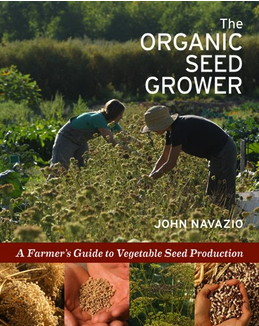 The Organic Seed Grower: A Farmer's Guide to Vegetable Seed Production, by John Navazio (Chelsea Green, 2013) ISBN: 1933392770
This is a fantastic resource for organic farmers or market gardeners interested in growing seed as a commercial crop.
It's a US book, but just as useful in the UK context, with really good clear crop-by-crop instructions on producing saleable-quality seed.
Patio Produce, by Paul Peacock (Spring Hill 2009) ISBN: 1905862288
Ideal for anyone who wants to grow vegetables in pots & containers. Very practical, tells you all you need to know to get a good harvest of vegetables even if you don't have a 'proper' garden to grow them in. Includes crop by crop details of pot sizes needed, best planting methods etc.
The
New Organic Grower, by Eliot Coleman (Chelsea Green, ISBN 0-930031-75-X)
The original and best. Intended for the small scale commercial market gardener, but most if not all of what he writes about applies to allotment-scale too. Very sound on cover-crops, rotations, soil improvement
etc, from a strong scientific base. This man knows what he's talking
about, worth reading no matter how experienced a grower you are (or indeed if you're a complete beginner). If you only get two books, get this and the Joy Larkcom.
"Growing Green" by Jenny Hall & Iain Tolhurst (The Vegan Organic Network 2006) ISBN: 0955222508
The answer to anyone who is looking for a British equivalent to Eliot Coleman.
This book is specifically about vegan organic growing - that is to say, growing with no animal inputs to your system. Since most smaller scale vegetable growers don't have the resources or wish to keep animals as part of their system, this makes it the perfect resource for those looking to generate fertility for their plot on site, without having to bring in outside manure or fertilisers. Again, very scientific and practical, no 'myths', just loads of good solid information. Probably mainly relevant to those growing at allotment scale or above, though an inspiring read for anyone.
"Seed
to Seed" by Suzanne Ashworth.(ISBN 1882424581).
This is the new edition, and a brilliant vegetable seed-saving book.
American, but a useful addition to Back Garden Seedsaving if you get really keen. Used as the standard reference
by the Seed Savers Exchange.
"Botany for Gardeners" by Brian Capon. (ISBN 0881926558)
Are you an experienced gardener but wish you understood just a bit more
about how your plants work? E.g. what is going on when for a seed germinates?
What does a leaf look like in cross-section close-up? And what are all
those pithy cells for in the middle? This concise little paperback book
is a handy reference to answer these questions.
It does assume a bit of scientific background knowledge but is ideal for someone who studied biology at school but wasn't paying much attention, or has forgotten a lot of what they learnt! Lots of nice photos and diagrams, text probably to about A-level standard or a bit higher in places.
"Breed
your own Vegetable Varieties" by Carol Deppe ( Chelsea
Green Pub Co; ISBN: 1890132721)
This is a brilliant introduction to veg breeding for the interested
amateur. Until 50 years ago, all gardeners were plant breeders - your
great-grandparents probably knew much more about this than we do.. .it's
not difficult, you just need to know how to do it, and the tradition
has been lost.
This book will give you the basics, and then if you're interested, the nitty-gritty too. Well written and inspiring, this is the second edition. It was this book that led us to the popping chickpeas.
"The Earth Care Manual" by Patrick Whitefield- ISBN
185623021X.
Well, this is really the manual to living in a sane and truly sustainable
manner. Covers an enormous range of subjects, ranging from raised bed
gardening to renewable energy to green building methods, to mention
just a few. It is equally interesting whether you are a total newcomer
to the subjects or already know something about them, and covers both
the 'big issues' and practical things that we can all do.
Heavy-Duty Reference Books:
Lost Crops Of the Incas (ISBN 0894991973)
If you wonder what inspired us to try all the various South American crops you'll find on our website, read Lost Crops of the Incas and you'll have the answer! Huge volume, produced by BOSTID (USA National Academy of Sciences)
by a panel of hundreds of international experts. Explanation of uses,
opportunities, limitations and traditions.
The only downside is that it doesn't actually tell you anything at all
about how to grow them. But still a great starting point, and will definitely inspire you to try new crops.
Now available to read online for free! See here
Lost Crops Of Africa - Vol 1: Grains and Vol 2: Vegetables (ISBN 0309049903)
Excellent books describing in detail the various grains and less known vegetables grown in
Africa. Again, produced by BOSTID (USA National Academy of Sciences)
by a panel of international experts. Explanation of uses,
opportunities, limitations and traditions.
These books are less relevant to gardeners in the UK, as the crops are on the whole less suited to our climate than those from South America, but still a fascinating read.
Also available to read online for free: See here and here
"Amaranth: Modern Prospects for an Ancient Crop"
(National Academy Press, Washington DC 1984) is the best further reference
if you want to know more about the history and potential of amaranths
as a grain and vegetable crop. This was our starting point for our Amaranth
experiments.
It is out of print, but you may be able to track it down through a library.
Worth the effort if you really get into amaranth.
You can read this one online too: see here
The CABI series of horticultural references
If you are a serious amateur or professional plant grower or breeder,
the following reference texts are excellent. These from CABI Publishing
are comprehensive and up-to-date, summarising state-of-the-art knowledge
about these crops. This includes growing, breeding, processing - everything.
They are expensive (about £30 each), and do assume a fair amount
of scientific knowledge (degree level). All available on-line from BOL
& Amazon, although its better to support your nearest small bookshop,
who will get them for you MUCH quicker anyway.
- Onions and other Vegetable Alliums (ISBN 085198 753 2) Superb!
- Carrots and Related Vegetable Umbelliferae (ISBN 085199 129 7) Great!
- Cucurbits (ISBN 085100 133 5 or 0851991335??) brilliant!
- Lettuce Endive and Chicory (ISBN 085199 285 4)
- Peppers - this one is awful. Truly tedious and not the least bit helpful. Don't bother with it.
- Brassicas - disappointing. Not as bad as the Peppers one, but not great.
'Principles of Plant Breeding' by R W Allard (The 1960 edition,
NOT the recent edition) ISBN 0 471 02315 9
For those wanting to 'move on from Deppe', this is THE book I would
strongly recommend. He does not give nitty-gritty details for specific
crops, but instead explains why you might want to breed in different
ways - e.g. when mass selection is better than backcrossing or vice
versa. It is great in that it explains without much maths.
Note that there is a newer edition just released at some absurdly high price (£100?), but with fewer pages, and judging by the publishers blurb, lots of info about modern genetic engineering methods. This original version from 1960 is much more relevant to the sort of breeding we are trying to do, and is cheaply available second hand . I got my copy through amazon for about 15 dollars after a week of putting up a 'book wanted' request.
I have seen others (Simmonds did a very similar volume that is totally & utterly incomprehensible), but this one is the most accessible, and does explain very clearly what you are trying to do in terms of backcrossing, pedigree breeding etc.
Out of print but easily obtainable on-line secondhand; try abebooks, amazon etc.
Farming references:
The Complete Book of Self-Sufficiency By John & Sally Seymour
The English book that started it all. Large-format reference paperback
that gives 1 page per topic. A bit superficial really - it doesn't go
into very much detail, so you'll definitely need other references too.
But it's an inspiring starting point, the advice is sound and is enough to point you on your way with
most things you want to try.
Also by John Seymour and illustrated by Sally, their autobiographical book 'The Fat of the Land' which tells the story of how they got into living off the land in the first place. Funny and informative, and much more realistic than the Complete Book, in that it makes it really clear that if you want to be self sufficient, you still need a lot of paid work too. Available from Carningli Press across the valley from our farm.
Five
Acres & Independence by M G Kains (ISBN 0486209741) Dover Books
A how-to-be-a-farmer book. American. Written in 1940 for the starting-out
small farmer, much of his advice is very sound today, especially for
the organic farmer. The first bit of the book covers business advice
and planning - very profit-oriented - but there is a wealth of minor
detail in the rest for forgotten techniques and technologies - clamping,
root cellars, ice-houses(!), draining, orchards, home-made septic tanks,
springs, poultry etc etc.